AI Automation for E-commerce Growth
Nov 15, 2025
Reading time: 6 min
E-commerce & Retail
AI Automation for E-commerce Growth
Nov 15, 2025
Reading time: 6 min
E-commerce & Retail
Introduction
The e-commerce industry is evolving faster than ever — and automation powered by Artificial Intelligence (AI) is at the heart of this transformation. From personalised shopping experiences to automated customer support and inventory management, AI is helping businesses grow smarter, faster, and more efficiently. In this article, we’ll explore how AI automation can fuel e-commerce growth, the tools that make it possible, and the future trends every online retailer should know.
Introduction
The e-commerce industry is evolving faster than ever — and automation powered by Artificial Intelligence (AI) is at the heart of this transformation. From personalised shopping experiences to automated customer support and inventory management, AI is helping businesses grow smarter, faster, and more efficiently. In this article, we’ll explore how AI automation can fuel e-commerce growth, the tools that make it possible, and the future trends every online retailer should know.
Personalised Shopping Experiences
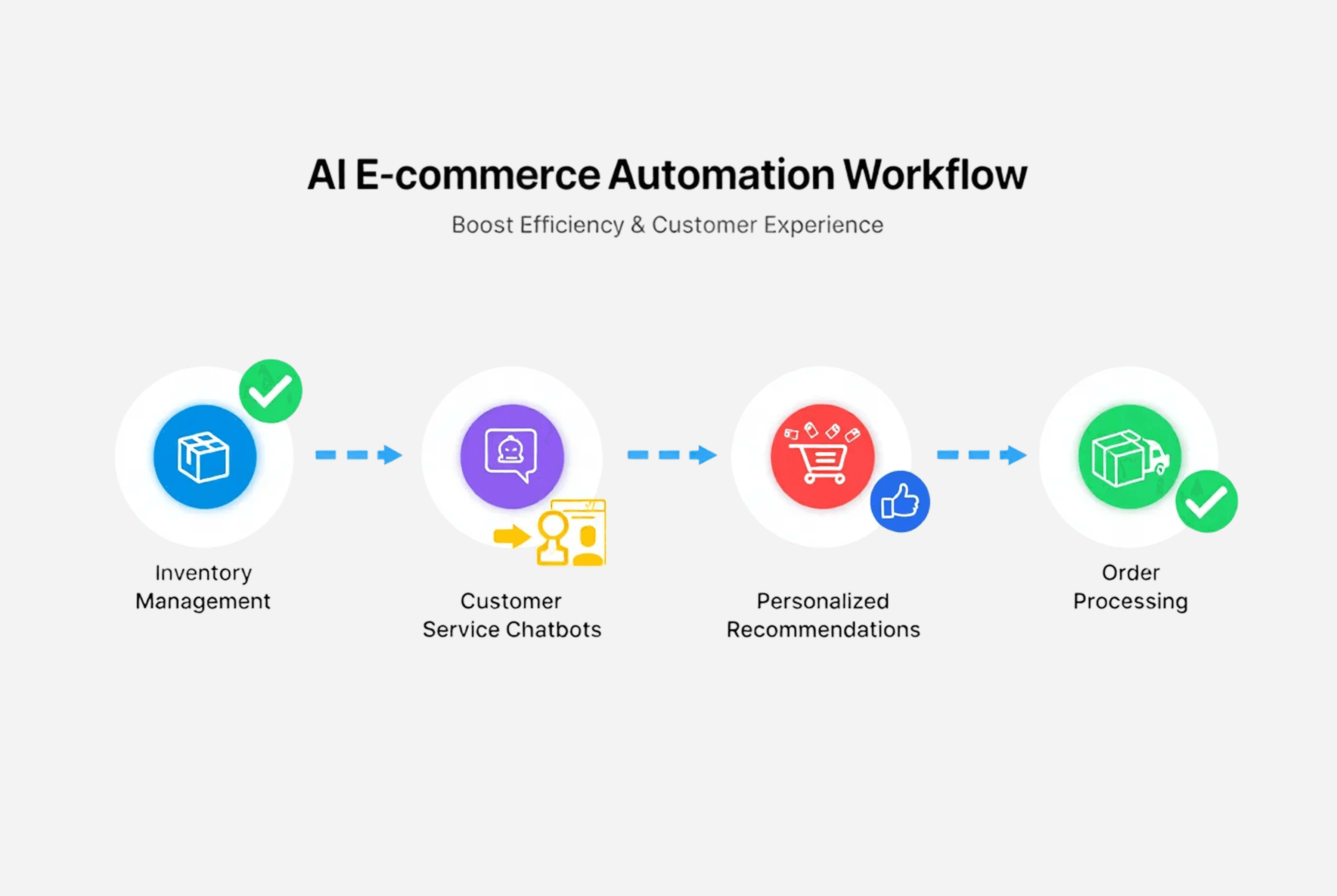
Modern consumers expect personalisation at every stage of their shopping journey. AI-driven automation enables e-commerce platforms to analyse user behaviour, past purchases, and browsing patterns to deliver tailored product recommendations in real time.
Example:
Amazon’s recommendation engine accounts for over 35% of its total sales, thanks to AI-powered product suggestions.
Result:
Enhanced customer satisfaction, increased sales, and stronger brand loyalty.
Personalised Shopping Experiences
Modern consumers expect personalisation at every stage of their shopping journey. AI-driven automation enables e-commerce platforms to analyse user behaviour, past purchases, and browsing patterns to deliver tailored product recommendations in real time.
Example:
Amazon’s recommendation engine accounts for over 35% of its total sales, thanks to AI-powered product suggestions.
Result:
Enhanced customer satisfaction, increased sales, and stronger brand loyalty.
Smarter Inventory Management
AI automation helps retailers manage stock levels efficiently by predicting demand trends and optimising restocking schedules. Instead of relying on manual tracking, AI systems use historical sales data, seasonal trends, and even social signals to forecast demand accurately.
Result: Faster response times and improved customer experience
Impact: Reduced storage costs and improved supply chain efficiency.
Smarter Inventory Management
AI automation helps retailers manage stock levels efficiently by predicting demand trends and optimising restocking schedules. Instead of relying on manual tracking, AI systems use historical sales data, seasonal trends, and even social signals to forecast demand accurately.
Result: Faster response times and improved customer experience
Impact: Reduced storage costs and improved supply chain efficiency.
Automated Customer Support
AI-powered chatbots and voice assistants are redefining how e-commerce businesses handle customer service. These virtual agents provide instant answers, 24/7 support, and multilingual communication — all without human intervention.
Result: Faster response times and improved customer experience
Impact: Customer service teams can focus on complex, high-value inquiries instead.
Automated Customer Support
AI-powered chatbots and voice assistants are redefining how e-commerce businesses handle customer service. These virtual agents provide instant answers, 24/7 support, and multilingual communication — all without human intervention.
Result: Faster response times and improved customer experience
Impact: Customer service teams can focus on complex, high-value inquiries instead.
Conclusion
A healthcare organisation used AI automation to process insurance claims. What used to take 3 hours per batch now takes just 45 minutes — a 75% reduction in processing time.
Intelligent Decision-Making with Predictive Analytics
AI automation will continue to evolve, making e-commerce smarter and more autonomous. The next wave includes generative AI for product descriptions, AI-driven pricing optimisation, and fully automated supply chain ecosystems.
Businesses that adopt early will gain a lasting competitive edge in the digital marketplace.
Conclusion
AI automation is no longer a luxury for e-commerce businesses — it’s a necessity. From enhancing customer experiences to streamlining operations and boosting profitability, AI is transforming every part of the online retail landscape.
Conclusion
A healthcare organisation used AI automation to process insurance claims. What used to take 3 hours per batch now takes just 45 minutes — a 75% reduction in processing time.
Intelligent Decision-Making with Predictive Analytics
AI automation will continue to evolve, making e-commerce smarter and more autonomous. The next wave includes generative AI for product descriptions, AI-driven pricing optimisation, and fully automated supply chain ecosystems.
Businesses that adopt early will gain a lasting competitive edge in the digital marketplace.
Conclusion
AI automation is no longer a luxury for e-commerce businesses — it’s a necessity. From enhancing customer experiences to streamlining operations and boosting profitability, AI is transforming every part of the online retail landscape.
Predictive Analytics for Better Decision-Making
AI automation analyses massive datasets to identify patterns and predict consumer behaviour. Retailers can forecast which products will perform best, when customers are likely to buy, and which promotions drive the most conversions.
Result: Data-driven marketing reduces guesswork and maximises ROI.
Impact: Smarter pricing, improved campaign targeting, and stronger profit margins.
Predictive Analytics for Better Decision-Making
AI automation analyses massive datasets to identify patterns and predict consumer behaviour. Retailers can forecast which products will perform best, when customers are likely to buy, and which promotions drive the most conversions.
Result: Data-driven marketing reduces guesswork and maximises ROI.
Impact: Smarter pricing, improved campaign targeting, and stronger profit margins.
AI-Powered Marketing Automation
From email campaigns to retargeting ads, AI automation personalises marketing efforts at scale. It segments audiences, times communications perfectly, and adjusts messaging based on user interactions.
Example: Tools like Klaviyo and Mailchimp AI integrations automatically send follow-up emails when a customer abandons their cart.
Result: Increased conversions and customer retention.
AI-Powered Marketing Automation
From email campaigns to retargeting ads, AI automation personalises marketing efforts at scale. It segments audiences, times communications perfectly, and adjusts messaging based on user interactions.
Example: Tools like Klaviyo and Mailchimp AI integrations automatically send follow-up emails when a customer abandons their cart.
Result: Increased conversions and customer retention.
Visual Search and AI Product Discovery
AI systems can identify unusual transaction patterns, helping prevent fraudulent activity in real time. Machine learning models analyse thousands of data points — such as user behaviour, location, and device — to ensure secure transactions.
Advantage: Reduces friction in product discovery.
Effect: Boosts engagement and purchase likelihood.
Fraud Detection and Payment Security
AI systems can identify unusual transaction patterns, helping prevent fraudulent activity in real time. Machine learning models analyse thousands of data points — such as user behaviour, location, and device — to ensure secure transactions.
Result: Increased trust and fewer chargebacks.
Bonus: Protects both the brand and customers.
Visual Search and AI Product Discovery
AI systems can identify unusual transaction patterns, helping prevent fraudulent activity in real time. Machine learning models analyse thousands of data points — such as user behaviour, location, and device — to ensure secure transactions.
Advantage: Reduces friction in product discovery.
Effect: Boosts engagement and purchase likelihood.
Fraud Detection and Payment Security
AI systems can identify unusual transaction patterns, helping prevent fraudulent activity in real time. Machine learning models analyse thousands of data points — such as user behaviour, location, and device — to ensure secure transactions.
Result: Increased trust and fewer chargebacks.
Bonus: Protects both the brand and customers.
Streamlined Order Fulfilment
AI automation optimises shipping routes, delivery schedules, and logistics operations. It can automatically assign orders to the nearest warehouse and choose the fastest delivery option.
Outcome: Quicker deliveries and lower operational costs.
Customer Benefit: Real-time order tracking and transparency.
Voice Commerce: The Future of Shopping
Voice assistants like Alexa and Google Assistant are changing how customers shop. AI automation helps e-commerce platforms integrate voice commerce — enabling hands-free ordering, payment, and delivery updates.
Trend: 30% of online purchases are expected to happen via voice by 2026.
Impact: A more intuitive and convenient shopping experience.
Streamlined Order Fulfilment
AI automation optimises shipping routes, delivery schedules, and logistics operations. It can automatically assign orders to the nearest warehouse and choose the fastest delivery option.
Outcome: Quicker deliveries and lower operational costs.
Customer Benefit: Real-time order tracking and transparency.
Voice Commerce: The Future of Shopping
Voice assistants like Alexa and Google Assistant are changing how customers shop. AI automation helps e-commerce platforms integrate voice commerce — enabling hands-free ordering, payment, and delivery updates.
Trend: 30% of online purchases are expected to happen via voice by 2026.
Impact: A more intuitive and convenient shopping experience.
Conclusion
A healthcare organisation used AI automation to process insurance claims. What used to take 3 hours per batch now takes just 45 minutes — a 75% reduction in processing time.
Intelligent Decision-Making with Predictive Analytics
AI automation will continue to evolve, making e-commerce smarter and more autonomous. The next wave includes generative AI for product descriptions, AI-driven pricing optimisation, and fully automated supply chain ecosystems.
Businesses that adopt early will gain a lasting competitive edge in the digital marketplace.
Conclusion
AI automation is no longer a luxury for e-commerce businesses — it’s a necessity. From enhancing customer experiences to streamlining operations and boosting profitability, AI is transforming every part of the online retail landscape.
Conclusion
A healthcare organisation used AI automation to process insurance claims. What used to take 3 hours per batch now takes just 45 minutes — a 75% reduction in processing time.
Intelligent Decision-Making with Predictive Analytics
AI automation will continue to evolve, making e-commerce smarter and more autonomous. The next wave includes generative AI for product descriptions, AI-driven pricing optimisation, and fully automated supply chain ecosystems.
Businesses that adopt early will gain a lasting competitive edge in the digital marketplace.
Conclusion
AI automation is no longer a luxury for e-commerce businesses — it’s a necessity. From enhancing customer experiences to streamlining operations and boosting profitability, AI is transforming every part of the online retail landscape.
Categories
Business Automation
Software
Industry Trends
Marketing & Sales
How-To Guides
Healthcare
How-To Guides
Customer Service
Case Studies
E-commerce & Retail
Categories
Business Automation
Software
Industry Trends
Marketing & Sales
How-To Guides
How-To Guides
Customer Service
Case Studies
E-commerce & Retail