How AI Automation Improved Efficiency by 60%
Nov 15, 2025
Reading time: 4 min
Case Studies
How AI Automation Improved Efficiency by 60%
Nov 15, 2025
Reading time: 4 min
Case Studies

Introduction
In the digital age, efficiency is the ultimate competitive edge. Businesses across industries are turning to AI automation to streamline operations, reduce manual effort, and enhance productivity. But how much difference can it really make?
Recent studies and real-world case examples reveal that AI automation can boost efficiency by as much as 60% — transforming how organisations manage workflows, serve customers, and make decisions.
In this article, we’ll explore how AI automation achieves this remarkable performance gain, what tools make it possible, and how you can apply the same strategies in your business.
Introduction
In the digital age, efficiency is the ultimate competitive edge. Businesses across industries are turning to AI automation to streamline operations, reduce manual effort, and enhance productivity. But how much difference can it really make?
Recent studies and real-world case examples reveal that AI automation can boost efficiency by as much as 60% — transforming how organisations manage workflows, serve customers, and make decisions.
In this article, we’ll explore how AI automation achieves this remarkable performance gain, what tools make it possible, and how you can apply the same strategies in your business.
Understanding AI Automation and Its Impact
AI automation combines artificial intelligence (AI) and automation technologies to handle repetitive, data-driven, and decision-making tasks with minimal human involvement.
Unlike traditional automation, which simply follows rules, AI automation learns, adapts, and improves over time using machine learning, natural language processing (NLP), and predictive analytics.
For example:
Faster task completion and reduced bottlenecks
Increased accuracy and fewer human errors
Streamlined workflows and communication
Smarter data-driven insights
When implemented effectively, AI automation doesn’t just make processes faster — it makes them smarter, leading to measurable efficiency gains across entire organisations.
Understanding AI Automation and Its Impact
AI automation combines artificial intelligence (AI) and automation technologies to handle repetitive, data-driven, and decision-making tasks with minimal human involvement.
Unlike traditional automation, which simply follows rules, AI automation learns, adapts, and improves over time using machine learning, natural language processing (NLP), and predictive analytics.
For example:
Faster task completion and reduced bottlenecks
Increased accuracy and fewer human errors
Streamlined workflows and communication
Smarter data-driven insights
When implemented effectively, AI automation doesn’t just make processes faster — it makes them smarter, leading to measurable efficiency gains across entire organisations.
The Numbers Behind 60% Efficiency Growth
Several global reports and business case studies have shown that AI automation can deliver 50–60% productivity improvements within the first year of adoption.
Key areas of improvement include:
A financial services firm automated its data entry and reporting system using RPA (Robotic Process Automation) integrated with AI, reducing manual hours by 65%.
A logistics company used AI for route optimisation and predictive maintenance, cutting downtime and boosting delivery efficiency by 58%.
A customer service department deployed AI chatbots and workflow tools, improving average response times by 60% while maintaining customer satisfaction scores.
These success stories highlight how AI can transform both front-end and back-end operations — improving efficiency, accuracy, and scalability simultaneously.
The Numbers Behind 60% Efficiency Growth
Several global reports and business case studies have shown that AI automation can deliver 50–60% productivity improvements within the first year of adoption.
Key areas of improvement include:
A financial services firm automated its data entry and reporting system using RPA (Robotic Process Automation) integrated with AI, reducing manual hours by 65%.
A logistics company used AI for route optimisation and predictive maintenance, cutting downtime and boosting delivery efficiency by 58%.
A customer service department deployed AI chatbots and workflow tools, improving average response times by 60% while maintaining customer satisfaction scores.
These success stories highlight how AI can transform both front-end and back-end operations — improving efficiency, accuracy, and scalability simultaneously.
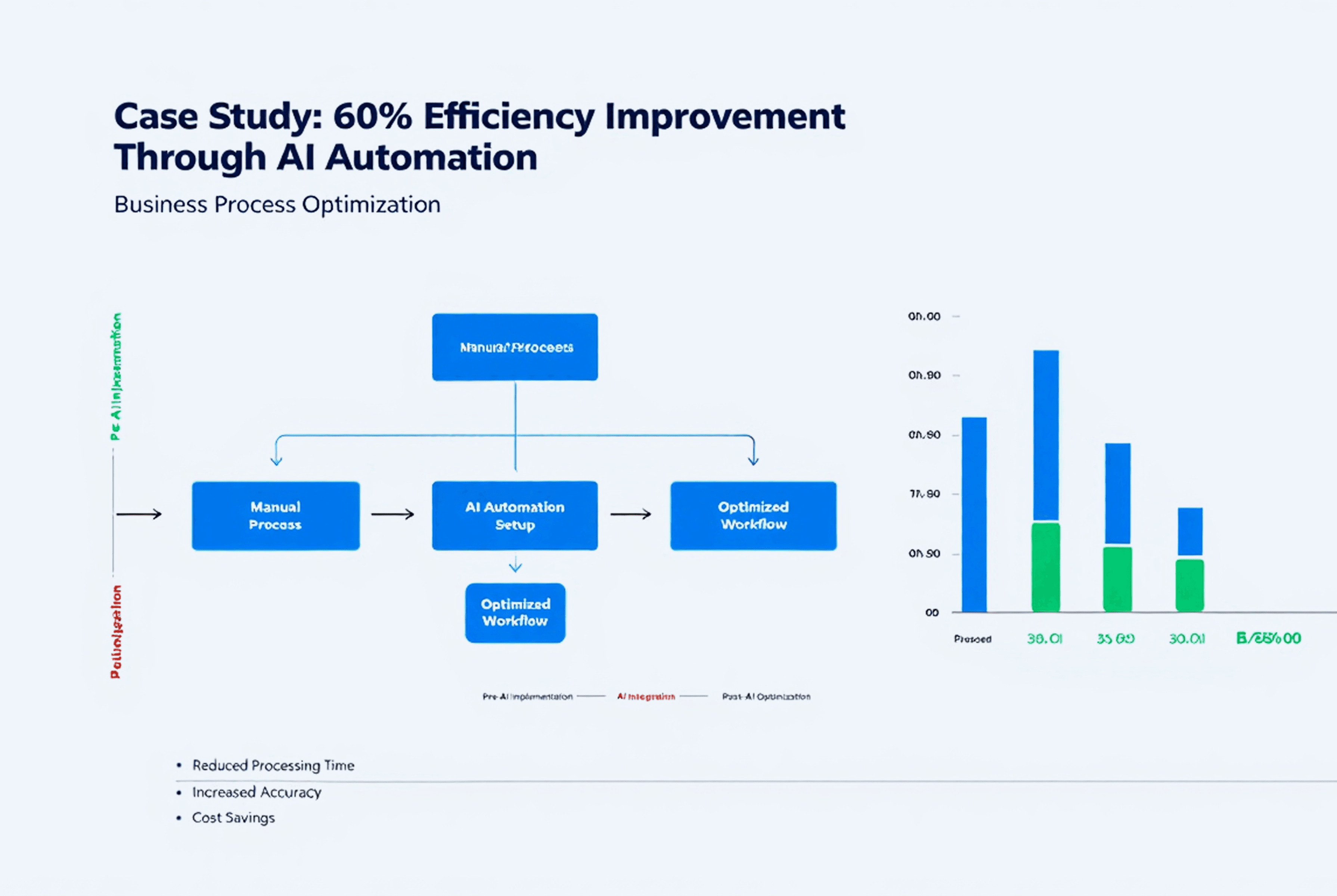
How AI Automation Achieves 60% Efficiency Gains
While the benefits are clear, AI-powered customer support also faces a few challenges — especially when it comes to balancing automation with empathy.
Automating Repetitive Manual Tasks
Repetitive tasks like data entry, scheduling, and report generation are often time-consuming and error-prone.
AI-powered tools like UiPath, Zapier, and Make (Integromat) can handle these automatically — working 24/7 with zero fatigue.
Impact:
Reduces manual workload by up to 70%
Frees employees to focus on strategic work
Eliminates human error in routine operations
Example:
A healthcare organisation used AI automation to process insurance claims. What used to take 3 hours per batch now takes just 45 minutes — a 75% reduction in processing time.
How AI Automation Achieves 60% Efficiency Gains
While the benefits are clear, AI-powered customer support also faces a few challenges — especially when it comes to balancing automation with empathy.
Automating Repetitive Manual Tasks
Repetitive tasks like data entry, scheduling, and report generation are often time-consuming and error-prone.
AI-powered tools like UiPath, Zapier, and Make (Integromat) can handle these automatically — working 24/7 with zero fatigue.
Impact:
Reduces manual workload by up to 70%
Frees employees to focus on strategic work
Eliminates human error in routine operations
Example:
A healthcare organisation used AI automation to process insurance claims. What used to take 3 hours per batch now takes just 45 minutes — a 75% reduction in processing time.

The Human-AI Partnership: A Key to Success
It’s important to remember that AI automation isn’t meant to replace humans — it’s designed to amplify human capabilities.
By taking over repetitive or analytical tasks, AI allows employees to:
Focus on creative problem-solving
Make faster, data-backed decisions
Change management: Employees must adapt to new systems and trust automation.
With proper onboarding, clear communication, and gradual rollout, these challenges can be managed successfully.
Challenges to Consider
Despite the advantages, businesses must navigate a few challenges:
By taking over repetitive or analytical tasks, AI allows employees to:
Integration complexity: Connecting AI with existing systems can require time and planning.
Data quality: Poor data leads to poor results — ensure accuracy in training data.
Change management: Employees must adapt to new systems and trust automation.
By taking over repetitive or analytical tasks, AI allows employees to:
Conclusion
AI automation has moved from being a futuristic concept to a practical necessity — and the results speak for themselves. By intelligently automating repetitive tasks, improving decision-making, and enhancing collaboration, businesses have reported efficiency boosts of up to 60% (and sometimes more).
The key lies in strategic implementation: starting small, choosing the right tools, and building a culture that embraces AI as a partner — not a replacement.
The Human-AI Partnership: A Key to Success
It’s important to remember that AI automation isn’t meant to replace humans — it’s designed to amplify human capabilities.
By taking over repetitive or analytical tasks, AI allows employees to:
Focus on creative problem-solving
Make faster, data-backed decisions
Change management: Employees must adapt to new systems and trust automation.
With proper onboarding, clear communication, and gradual rollout, these challenges can be managed successfully.
Challenges to Consider
Despite the advantages, businesses must navigate a few challenges:
By taking over repetitive or analytical tasks, AI allows employees to:
Integration complexity: Connecting AI with existing systems can require time and planning.
Data quality: Poor data leads to poor results — ensure accuracy in training data.
Change management: Employees must adapt to new systems and trust automation.
By taking over repetitive or analytical tasks, AI allows employees to:
Conclusion
AI automation has moved from being a futuristic concept to a practical necessity — and the results speak for themselves. By intelligently automating repetitive tasks, improving decision-making, and enhancing collaboration, businesses have reported efficiency boosts of up to 60% (and sometimes more).
The key lies in strategic implementation: starting small, choosing the right tools, and building a culture that embraces AI as a partner — not a replacement.
Intelligent Decision-Making with Predictive Analytics
AI automation doesn’t just execute — it analyses and predicts. By using predictive analytics, businesses can anticipate issues before they arise and make proactive decisions.
Use cases:
Forecasting sales and inventory levels
Identifying performance bottlenecks
Predicting customer behaviour and churn
Result:
Smarter forecasting reduces waste, increases agility, and improves operational planning — directly contributing to a 60% or higher efficiency improvement.
Intelligent Decision-Making with Predictive Analytics
AI automation doesn’t just execute — it analyses and predicts. By using predictive analytics, businesses can anticipate issues before they arise and make proactive decisions.
Use cases:
Forecasting sales and inventory levels
Identifying performance bottlenecks
Predicting customer behaviour and churn
Result:
Smarter forecasting reduces waste, increases agility, and improves operational planning — directly contributing to a 60% or higher efficiency improvement.
Smarter Communication and Customer Support
AI chatbots, virtual assistants, and automated CRM tools are reshaping customer service. These systems can handle up to 80% of routine customer queries instantly.
Examples:
ChatGPT-based bots resolve customer issues in seconds.
Zendesk AI classifies and routes tickets automatically.
Drift and Intercom nurture leads through automated, personalised chat flows. Cus on complex issues — leading to higher satisfaction and faster turnaround.
Smarter Communication and Customer Support
AI chatbots, virtual assistants, and automated CRM tools are reshaping customer service. These systems can handle up to 80% of routine customer queries instantly.
Examples:
ChatGPT-based bots resolve customer issues in seconds.
Zendesk AI classifies and routes tickets automatically.
Drift and Intercom nurture leads through automated, personalised chat flows. Cus on complex issues — leading to higher satisfaction and faster turnaround.

Real-Time Data Processing and Reporting
Data is the foundation of modern business decisions — and AI automation ensures it’s processed faster and more accurately.
AI tools can extract, clean, and analyse vast data sets in seconds, creating reports that once took analysts days to prepare.
Example:
A retail company automated its sales data analysis pipeline. Weekly reports that required 20 hours of manual work were reduced to 2 hours — a 90% improvement in efficiency.
Real-Time Data Processing and Reporting
Data is the foundation of modern business decisions — and AI automation ensures it’s processed faster and more accurately.
AI tools can extract, clean, and analyse vast data sets in seconds, creating reports that once took analysts days to prepare.
Example:
A retail company automated its sales data analysis pipeline. Weekly reports that required 20 hours of manual work were reduced to 2 hours — a 90% improvement in efficiency.
Tools That Power AI Automation Efficiency
If you’re looking to replicate these results, here are some top tools that can help automate your workflows and enhance productivity:
Category | Tool Examples | Key Benefit |
|---|---|---|
Workflow Automation | Zapier, Make, n8n | Automates cross-app workflows |
Data Management | Airtable, Power Automate | Automates data syncing and reporting |
HR Automation | SaaSLab HR, BambooHR | Streamlines HR operations |
Customer Support | Intercom, Zendesk AI | Automates customer support |
Marketing Automation | HubSpot, ActiveCampaign, Jasper AI | Automates marketing tasks |
These platforms help businesses reduce operational friction while maintaining flexibility and scalability.
Tools That Power AI Automation Efficiency
If you’re looking to replicate these results, here are some top tools that can help automate your workflows and enhance productivity:
Category | Tool Examples | Key Benefit |
|---|---|---|
Workflow Automation | Zapier, Make, n8n | Automates cross-app workflows |
Data Management | Airtable, Power Automate | Automates data syncing and reporting |
HR Automation | SaaSLab HR, BambooHR | Streamlines HR operations |
Customer Support | Intercom, Zendesk AI | Automates customer support |
Marketing Automation | HubSpot, ActiveCampaign, Jasper AI | Automates marketing tasks |
These platforms help businesses reduce operational friction while maintaining flexibility and scalability.
Real-World Case Study: Efficiency in Action
Let’s look at a simplified case of a mid-sized marketing agency that integrated AI automation into its daily operations.
Before AI:
Manual client onboarding
Time-consuming campaign reporting
Inconsistent follow-ups and delays
50+ hours per week spent on repetitive tasks
After AI Integration:
AI automated client communication via chatbots
Reporting dashboards are updated automatically with analytics tools
AI-driven scheduling optimised team workloads
Tasks that took 10 hours now take 3 hours
Result:
The agency reported a 61% improvement in operational efficiency, 40% faster turnaround times, and a noticeable increase in employee satisfaction.
Real-World Case Study: Efficiency in Action
Let’s look at a simplified case of a mid-sized marketing agency that integrated AI automation into its daily operations.
Before AI:
Manual client onboarding
Time-consuming campaign reporting
Inconsistent follow-ups and delays
50+ hours per week spent on repetitive tasks
After AI Integration:
AI automated client communication via chatbots
Reporting dashboards are updated automatically with analytics tools
AI-driven scheduling optimised team workloads
Tasks that took 10 hours now take 3 hours
Result:
The agency reported a 61% improvement in operational efficiency, 40% faster turnaround times, and a noticeable increase in employee satisfaction.
The Human-AI Partnership: A Key to Success
It’s important to remember that AI automation isn’t meant to replace humans — it’s designed to amplify human capabilities.
By taking over repetitive or analytical tasks, AI allows employees to:
Focus on creative problem-solving
Make faster, data-backed decisions
Change management: Employees must adapt to new systems and trust automation.
With proper onboarding, clear communication, and gradual rollout, these challenges can be managed successfully.
Challenges to Consider
Despite the advantages, businesses must navigate a few challenges:
By taking over repetitive or analytical tasks, AI allows employees to:
Integration complexity: Connecting AI with existing systems can require time and planning.
Data quality: Poor data leads to poor results — ensure accuracy in training data.
Change management: Employees must adapt to new systems and trust automation.
By taking over repetitive or analytical tasks, AI allows employees to:
Conclusion
AI automation has moved from being a futuristic concept to a practical necessity — and the results speak for themselves. By intelligently automating repetitive tasks, improving decision-making, and enhancing collaboration, businesses have reported efficiency boosts of up to 60% (and sometimes more).
The key lies in strategic implementation: starting small, choosing the right tools, and building a culture that embraces AI as a partner — not a replacement.
The Human-AI Partnership: A Key to Success
It’s important to remember that AI automation isn’t meant to replace humans — it’s designed to amplify human capabilities.
By taking over repetitive or analytical tasks, AI allows employees to:
Focus on creative problem-solving
Make faster, data-backed decisions
Change management: Employees must adapt to new systems and trust automation.
With proper onboarding, clear communication, and gradual rollout, these challenges can be managed successfully.
Challenges to Consider
Despite the advantages, businesses must navigate a few challenges:
By taking over repetitive or analytical tasks, AI allows employees to:
Integration complexity: Connecting AI with existing systems can require time and planning.
Data quality: Poor data leads to poor results — ensure accuracy in training data.
Change management: Employees must adapt to new systems and trust automation.
By taking over repetitive or analytical tasks, AI allows employees to:
Conclusion
AI automation has moved from being a futuristic concept to a practical necessity — and the results speak for themselves. By intelligently automating repetitive tasks, improving decision-making, and enhancing collaboration, businesses have reported efficiency boosts of up to 60% (and sometimes more).
The key lies in strategic implementation: starting small, choosing the right tools, and building a culture that embraces AI as a partner — not a replacement.
Categories
Business Automation
Software
Industry Trends
Marketing & Sales
How-To Guides
Healthcare
How-To Guides
Customer Service
Case Studies
E-commerce & Retail
Categories
Business Automation
Software
Industry Trends
Marketing & Sales
How-To Guides
How-To Guides
Customer Service
Case Studies
E-commerce & Retail