Top Trends in AI Automation for 2025
Nov 14, 2025
Reading time: 7 min
Industry Insights
Top Trends in AI Automation for 2025
Nov 14, 2025
Reading time: 7 min
Industry Insights
Introduction
As artificial intelligence (AI) continues to evolve at lightning speed, automation has become the cornerstone of modern business operations. From marketing and finance to healthcare and logistics, AI automation is transforming how organisations work — improving efficiency, accuracy, and scalability like never before.
The year 2025 marks a new era for AI-driven transformation. In this article, we’ll explore the top AI automation trends shaping industries in 2025, how they’re driving innovation, and what they mean for the future of work.
Introduction
As artificial intelligence (AI) continues to evolve at lightning speed, automation has become the cornerstone of modern business operations. From marketing and finance to healthcare and logistics, AI automation is transforming how organisations work — improving efficiency, accuracy, and scalability like never before.
The year 2025 marks a new era for AI-driven transformation. In this article, we’ll explore the top AI automation trends shaping industries in 2025, how they’re driving innovation, and what they mean for the future of work.
Hyper-Automation Becomes the New Normal
Hyper-automation — the combination of AI, machine learning (ML), robotic process automation (RPA), and data analytics — is redefining business efficiency. Unlike traditional automation, hyper-automation aims to automate every possible business process, from customer service to financial operations.
By 2025, companies will be adopting hyper-automation to:
Minimise human errors
Minimise human errors
Reduce operational costs
Enhance decision-making with real-time data
Example:
Enterprises are integrating platforms like UiPath, Automation Anywhere, and Blue Prism with AI tools to create smart, end-to-end automation workflows that learn and improve over time.
Hyper-Automation Becomes the New Normal
Hyper-automation — the combination of AI, machine learning (ML), robotic process automation (RPA), and data analytics — is redefining business efficiency. Unlike traditional automation, hyper-automation aims to automate every possible business process, from customer service to financial operations.
By 2025, companies will be adopting hyper-automation to:
Minimise human errors
Minimise human errors
Reduce operational costs
Enhance decision-making with real-time data
Example:
Enterprises are integrating platforms like UiPath, Automation Anywhere, and Blue Prism with AI tools to create smart, end-to-end automation workflows that learn and improve over time.
AI-Driven Decision Intelligence
Data is only valuable when it leads to better decisions. That’s where decision intelligence (DI) comes in — combining AI and analytics to guide smarter business strategies.
In 2025, organisations will increasingly rely on AI models that analyse massive datasets and predict the best outcomes across departments — from marketing to supply chain.
Use case examples:
Predicting consumer demand for products
Optimising pricing models based on market behaviour
Forecasting financial performance with AI-based analytics
AI-powered DI tools such as IBM Watson and Google Vertex AI are empowering businesses to make data-driven, context-aware, and automated decisions faster than ever.
AI-Driven Decision Intelligence
Data is only valuable when it leads to better decisions. That’s where decision intelligence (DI) comes in — combining AI and analytics to guide smarter business strategies.
In 2025, organisations will increasingly rely on AI models that analyse massive datasets and predict the best outcomes across departments — from marketing to supply chain.
Use case examples:
Predicting consumer demand for products
Optimising pricing models based on market behaviour
Forecasting financial performance with AI-based analytics
AI-powered DI tools such as IBM Watson and Google Vertex AI are empowering businesses to make data-driven, context-aware, and automated decisions faster than ever.
AI and Robotic Process Automation (RPA) Integration
The fusion of AI and RPA is one of the most powerful automation trends of 2025. While RPA automates repetitive tasks, AI adds intelligence, adaptability, and learning to these processes.
This combination enables systems to:
Understand unstructured data (like emails or documents)
Handle exceptions and decision-making tasks
Continuously improve performance through machine learning
Example:
Banks and insurance firms use AI-integrated RPA bots to process claims, verify customer documents, and detect fraud in real time — all without human intervention.
AI and Robotic Process Automation (RPA) Integration
The fusion of AI and RPA is one of the most powerful automation trends of 2025. While RPA automates repetitive tasks, AI adds intelligence, adaptability, and learning to these processes.
This combination enables systems to:
Understand unstructured data (like emails or documents)
Handle exceptions and decision-making tasks
Continuously improve performance through machine learning
Example:
Banks and insurance firms use AI-integrated RPA bots to process claims, verify customer documents, and detect fraud in real time — all without human intervention.
Conclusion
The world of AI automation in 2025 is defined by intelligence, efficiency, and innovation. From hyper-automation and decision intelligence to generative AI and predictive maintenance, these trends are reshaping how businesses operate — making them smarter, faster, and more adaptive than ever.
As organisations embrace these technologies, the key to success lies in strategic adoption — understanding where automation adds the most value and ensuring it complements, rather than replaces, human creativity.
Conclusion
The world of AI automation in 2025 is defined by intelligence, efficiency, and innovation. From hyper-automation and decision intelligence to generative AI and predictive maintenance, these trends are reshaping how businesses operate — making them smarter, faster, and more adaptive than ever.
As organisations embrace these technologies, the key to success lies in strategic adoption — understanding where automation adds the most value and ensuring it complements, rather than replaces, human creativity.
AI-Powered Workflow Optimisation
As businesses scale, managing workflows manually becomes inefficient. In 2025, AI automation tools will be streamlining complex operations by intelligently assigning tasks, predicting delays, and optimising resource allocation.
Example: AI in Project Management: Tools like Notion AI and ClickUp AI predict project timelines and suggest workload adjustments.
AI in Project Management: Tools like Notion AI and ClickUp AI predict project timelines and suggest workload adjustments.
AI in HR Automation: Systems like BambooHR and SaaSLab HR automate recruitment, onboarding, and performance tracking.
By using automation to handle repetitive admin tasks, employees can focus on strategic, creative, and high-impact work.
AI-Powered Workflow Optimisation
As businesses scale, managing workflows manually becomes inefficient. In 2025, AI automation tools will be streamlining complex operations by intelligently assigning tasks, predicting delays, and optimising resource allocation.
Example: AI in Project Management: Tools like Notion AI and ClickUp AI predict project timelines and suggest workload adjustments.
AI in Project Management: Tools like Notion AI and ClickUp AI predict project timelines and suggest workload adjustments.
AI in HR Automation: Systems like BambooHR and SaaSLab HR automate recruitment, onboarding, and performance tracking.
By using automation to handle repetitive admin tasks, employees can focus on strategic, creative, and high-impact work.
Generative AI for Business Automation
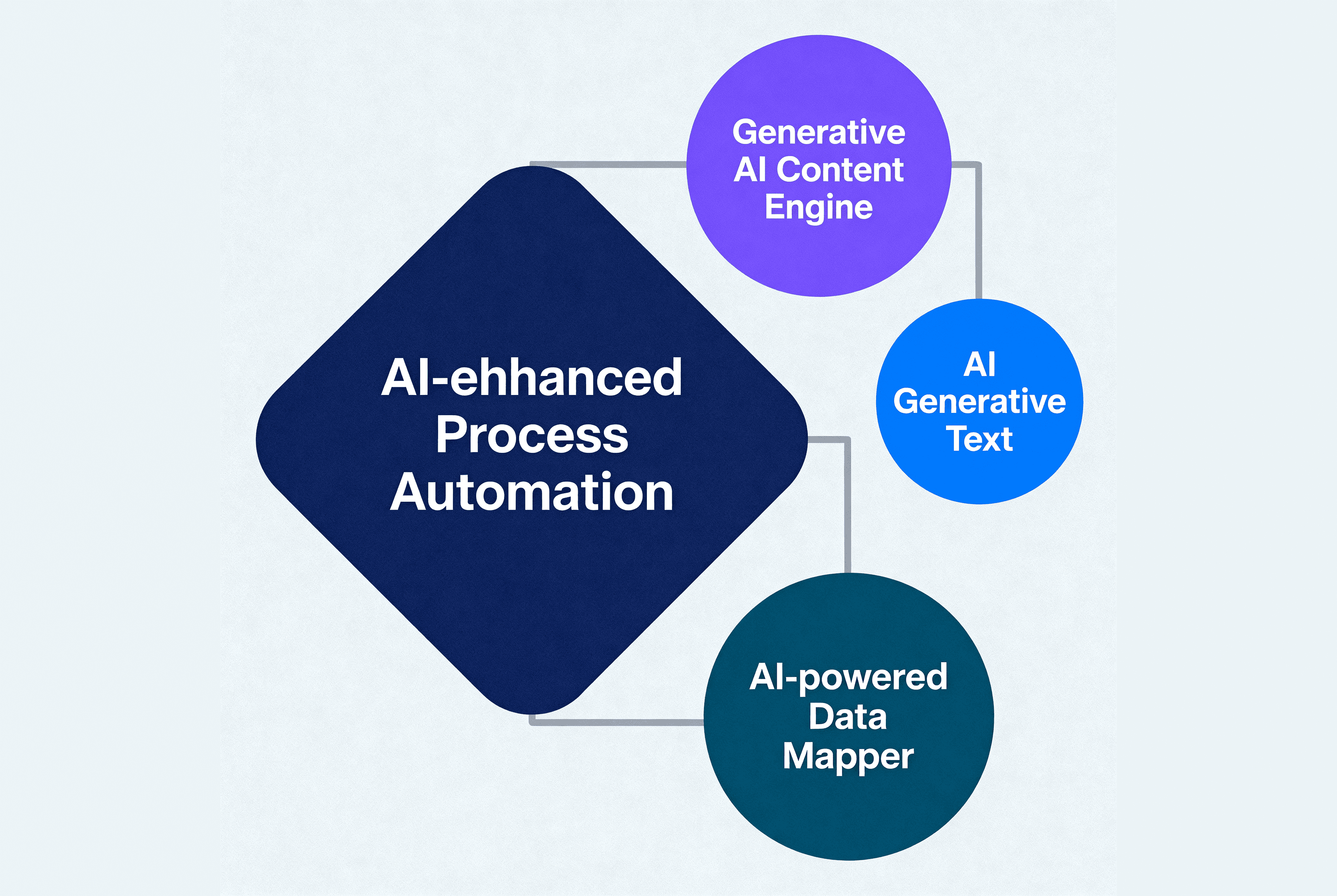
2025 will see Generative AI (like GPT-based systems) become a critical driver of automation. These models don’t just analyse data — they create text, images, code, and even business strategies.
Applications include:
Writing emails, blogs, and ad copy automatically
Generating code for websites and apps
Designing product concepts or marketing visuals
Creating automated reports and presentations
Generative AI tools such as ChatGPT, Jasper, Midjourney, and Synthesia are helping teams save hours while maintaining creativity and quality.
Generative AI for Business Automation
2025 will see Generative AI (like GPT-based systems) become a critical driver of automation. These models don’t just analyse data — they create text, images, code, and even business strategies.
Applications include:
Writing emails, blogs, and ad copy automatically
Generating code for websites and apps
Designing product concepts or marketing visuals
Creating automated reports and presentations
Generative AI tools such as ChatGPT, Jasper, Midjourney, and Synthesia are helping teams save hours while maintaining creativity and quality.
No-Code and Low-Code AI Platforms

AI automation is no longer reserved for developers. The rise of no-code and low-code AI platforms empowers non-technical users to build custom automation workflows with simple drag-and-drop tools.
Benefits:
Faster deployment
Lower development costs
Greater accessibility for small and mid-size businesses
Platforms like Zapier, Make (formerly Integromat), and Airtable AI are making AI automation more democratised than ever, allowing anyone to automate workflows without writing code.
No-Code and Low-Code AI Platforms
AI automation is no longer reserved for developers. The rise of no-code and low-code AI platforms empowers non-technical users to build custom automation workflows with simple drag-and-drop tools.
Benefits:
Faster deployment
Lower development costs
Greater accessibility for small and mid-size businesses
Platforms like Zapier, Make (formerly Integromat), and Airtable AI are making AI automation more democratised than ever, allowing anyone to automate workflows without writing code.
AI in Predictive Maintenance
In manufacturing and logistics, predictive maintenance powered by AI automation is revolutionising efficiency. By analysing sensor data, AI can predict equipment failures before they happen, preventing costly downtime.
Example:
Factories use AI-driven IoT sensors to monitor machine health, detect early signs of wear, and automatically schedule repairs — saving millions in maintenance costs.
AI in Predictive Maintenance
In manufacturing and logistics, predictive maintenance powered by AI automation is revolutionising efficiency. By analysing sensor data, AI can predict equipment failures before they happen, preventing costly downtime.
Example:
Factories use AI-driven IoT sensors to monitor machine health, detect early signs of wear, and automatically schedule repairs — saving millions in maintenance costs.
Human-AI Collaboration: The Augmented Workforce
The future of work isn’t about humans vs. AI — it’s about humans working with AI. In 2025, AI automation is creating the augmented workforce, where humans handle creativity and strategy while AI takes care of repetitive and analytical tasks.
This synergy enhances productivity, reduces burnout, and allows businesses to scale operations efficiently while maintaining a human touch.
Human-AI Collaboration: The Augmented Workforce
The future of work isn’t about humans vs. AI — it’s about humans working with AI. In 2025, AI automation is creating the augmented workforce, where humans handle creativity and strategy while AI takes care of repetitive and analytical tasks.
This synergy enhances productivity, reduces burnout, and allows businesses to scale operations efficiently while maintaining a human touch.
Conclusion
The world of AI automation in 2025 is defined by intelligence, efficiency, and innovation. From hyper-automation and decision intelligence to generative AI and predictive maintenance, these trends are reshaping how businesses operate — making them smarter, faster, and more adaptive than ever.
As organisations embrace these technologies, the key to success lies in strategic adoption — understanding where automation adds the most value and ensuring it complements, rather than replaces, human creativity.
Conclusion
The world of AI automation in 2025 is defined by intelligence, efficiency, and innovation. From hyper-automation and decision intelligence to generative AI and predictive maintenance, these trends are reshaping how businesses operate — making them smarter, faster, and more adaptive than ever.
As organisations embrace these technologies, the key to success lies in strategic adoption — understanding where automation adds the most value and ensuring it complements, rather than replaces, human creativity.
Categories
Business Automation
Software
Industry Trends
Marketing & Sales
How-To Guides
Healthcare
How-To Guides
Customer Service
Case Studies
E-commerce & Retail
Categories
Business Automation
Software
Industry Trends
Marketing & Sales
How-To Guides
How-To Guides
Customer Service
Case Studies
E-commerce & Retail